John
Prettyjohns VC grave (11th June 1823 to 20th
January 1887)
Though John Prettyjohns died in
1887 the Royal Marines honour him every autumn - even now after over 130 years.
A bugler plays the Last Post at an annual memorial that attracts Marines,
cadets, veterans and civic leaders. Only four of these events happen across the
country.
I found John in one of the older sections of Southern Cemetery near Manchester. Most of the time-darkened headstones are gathering a patina of green but after withstanding all weathers I suppose this is to be expected. The grass isn’t worn down by visitors and the only people who pass through this section are council workers with lawnmowers. Anyone associated with the dead here will have died years ago I suppose. John gets a few visitors though and I’d guess anyone snooping around that doesn’t know about him will be drawn in by the white headstone to read about who lies there.
John
was born in Devon and called John Pethyjohns (later
changed the surname.) As he couldn’t read or write and he worked as an
agricultural labourer until he joined the Marine Light Infantry in Plymouth.
People couldn’t pick up “Pethyjohns” due to his
strong Devon accent so he changed it to “Prettyjohn”
(the final "s" is added on some documentation and on his gravestone.)
Aged
22 on in March 1845 he embarked on HMS Melampus
heading to south-east America and the East Indies. Records show he was
physically flogged for a misdemeanour (not sure what he did.) This didn’t put
him off sailing and by age 29 he had been promoted to corporal and had
travelled the world extensively. By 31 he was fighting in The Crimean War on
land between Russia and the Ukraine (they’re still arguing about this terrain
to this day.) He was a long way from Manchester where’s he buried.
On
5th November 1854 the 31-year-old was fighting in the Battle of Inkerman where the British, French and Ottoman Empire were
fighting the Imperial Russian Army. This war would finally break the spine of
the Russian force. One morning three hundred men were in the trenches preparing
breakfast. Gunfire sounds came from Sebastopol and then from the rear. Gunfire
alone must be frightening but the trenches were festooned in fog and smoke and
nothing could be determined which created terror. The soldiers couldn’t see
where the enemy were. The bugle sounded and men were ordered to prepare to
fight. They were told vast columns of the enemy were moving up from the rear.
Bullets poured in and they were under attack. The Sergeant-Major was the first
man killed. However their combined manic firepower drove the enemy back into
the fog and smoke. As nobody could see clearly the Commanding Officer received
orders to stay back and hold their position.
They
were instructed to clear The Inkermann Caves which
were occupied by Russian sharpshooters who were picking off officers and
gunners. Anyone could take a bullet in the head and some did. The problem was
that they had almost run out of bullets. Holding their position amid fog and
smoke had almost depleted most of their bullet pile. How they cleared the caves
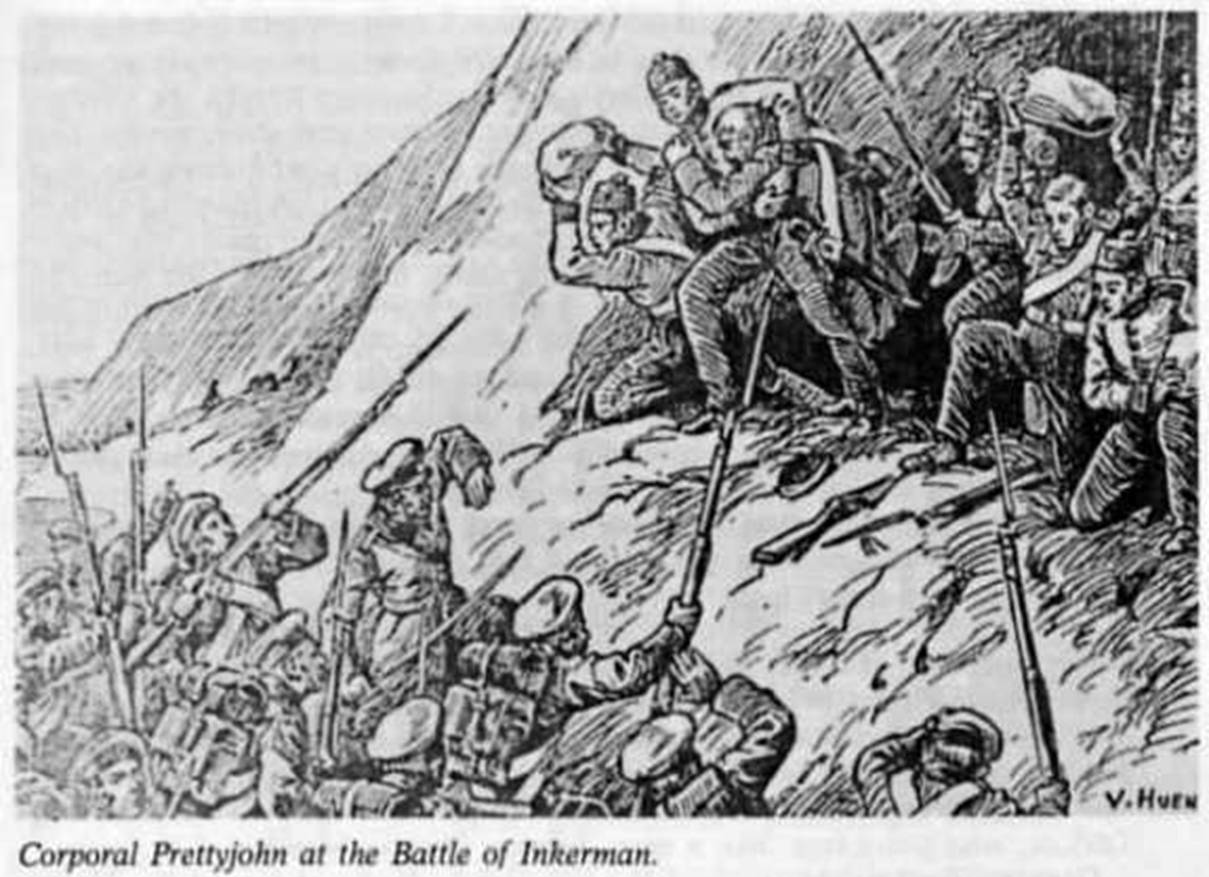
of Russians is unknown but they succeeded. Suddenly from atop a hill John
spotted a line of Russian soldiers creeping toward them in a single file. He
warned the unarmed men they were in for trouble and “it will be every man for
himself in a few minutes.” He ordered them to collect stones and rocks and pelt
the Russians when he shouted. When the first Russian appeared John grabbed him
and threw him down the hill, a shower of stones and rocks following him. The
hills gradient combined with a line of hollering charging men hurling rocks
sent the Russians tumbling over one another. Even though the Russians had guns
they were in a poor strategic position and retreated. Had they known John and
his platoon had no guns they’d have probably killed them all.
John
was the first Royal Marine to be awarded a Victoria Cross medal. He also
received the huge sum of £20 for Distinguished Conduct in the Field. He was
presented with the medal while in China as he had sailed onto Hong Kong and
then China to fight more battles. He’d been promoted to Colour-Sergeant by this
time but I’m sure the medal was better than any promotion. He served in
Calcutta and was eventually discharged from service on 16th June 1865 aged 42
after 21 years of fighting. He’d spent over 16 years at sea or abroad.
He
retired to Manchester area and became a Golf Club steward at Whalley Range Bowling Club in nearby Withington. He died at
his home aged 63 on 20th January 1887. The Victoria Cross medal is held at the
Royal Marines Museum in Portsmouth. He had married a distant cousin Elizabeth
at Plymouth Registry Office and they had two daughters. All are reunited here
under this headstone.
When you’re near it you can’t miss
the bold white headstone…


Touching the “VC”…and there it is
(blue ribbon)…