William
Coltman (17th November 1891 to 29th
June 1974)
Here I am Winshill
village in Staffordshire to look for the grave of William Coltman,
another Victoria Cross recipient. William was born not far from where his brave
bones lie now.
It’s strange that he ever fought as he came from
a profoundly religious family who followed the Plymouth Brethren (considered to
be the stricter side of the Christian Brethren church.) They were wholly
opposed to war and killing. It’s a mystery why in 1915 the 16-year-old boy
volunteered to fight with the British Army in the First World War. He began as
a lowly rifleman but rose to lance corporal. Oddly his Christian beliefs exempted
him from taking up arms so he became a stretcher bearer and won all his medals
without firing a single bullet.
A decade after joining up he was still alive. On Saturday
28th September 1918 he was fighting near Bellenglise
in northern France. Many wounded comrades kept getting left behind on No Man’s
Land as the two nations fought bloodily. Some had been shot by machine guns and
others felled by explosions. Against walls of perpetual gunfire William went
forward alone found casualties, dressed them and brought them back to safety.
His fearlessness and devotion heralded a Victoria Cross medal.
Less than week later he gained another medal for
bravery - the Distinguished Conduct Medal (DCM). He was fighting in Mannequin
Hill near Sequehart in Northern France. On 3rd and 4th October 1918 he saw
men from his regiment from getting left behind as they retreated. He was having
none of it and saved injured men, on three successive occasions carrying comrades
on his back to safety. For the next 48 hours he tended the wounded unceasingly
without sleep or rest.
This man was invincible – he’d already gained two
medals for acts of selfless bravery in 1917 (a) rescuing a wounded officer from
no man’s land in February 1917, (b) removing lights from an ammunitions dump to
prevent more mortar bombs, (c) tending injured men when a company headquarters
was mortared and (d) organising a rescue digging party when a trench tunnel
collapsed trapping many men.
He was invested with his Victoria Cross by King
George V at Buckingham Palace on 22nd May 1919. When the First World War ended
he returned home to Burton on Trent and took a job as a groundskeeper with the
town's Parks Department. As the Second World War raged he commanded the Burton
on Trent Army Cadet Force as captain. He retired from his job in 1963 and died
aged 82.
I found his grave was in the churchyard behind St
Mark’s parish church. The red wreath pulled me across the grass. William’s
buried here with his wife Eleanor. Despite relentless soldiering and almost
suicidal acts of bravery the Plymouth Brethren church refuse to recognise
awards gained from conflict and The Victoria Cross Trust look after the grave.
Strangely his wife died quite early and William had twenty-six years on his
own. I’ve visited lots of these VC soldiers and their wives nearly always
outlive them.
That Sunday afternoon I didn’t see a single soul
in the cemetery excepting a man passing with a dog. I hope the following day he
stopped to observe the grave of the lad who was only 17-year-old when he
witnessed boundless bloody horror on the fields in the battle of Gommecourt but was determined to be a stretcher-bearer. All
those medals without firing a single shot, that’s pretty good work. A full line
was carved in the headstone just to include his achievements, “VC, DCM &
Bar, MM & Bar.” Blimey.


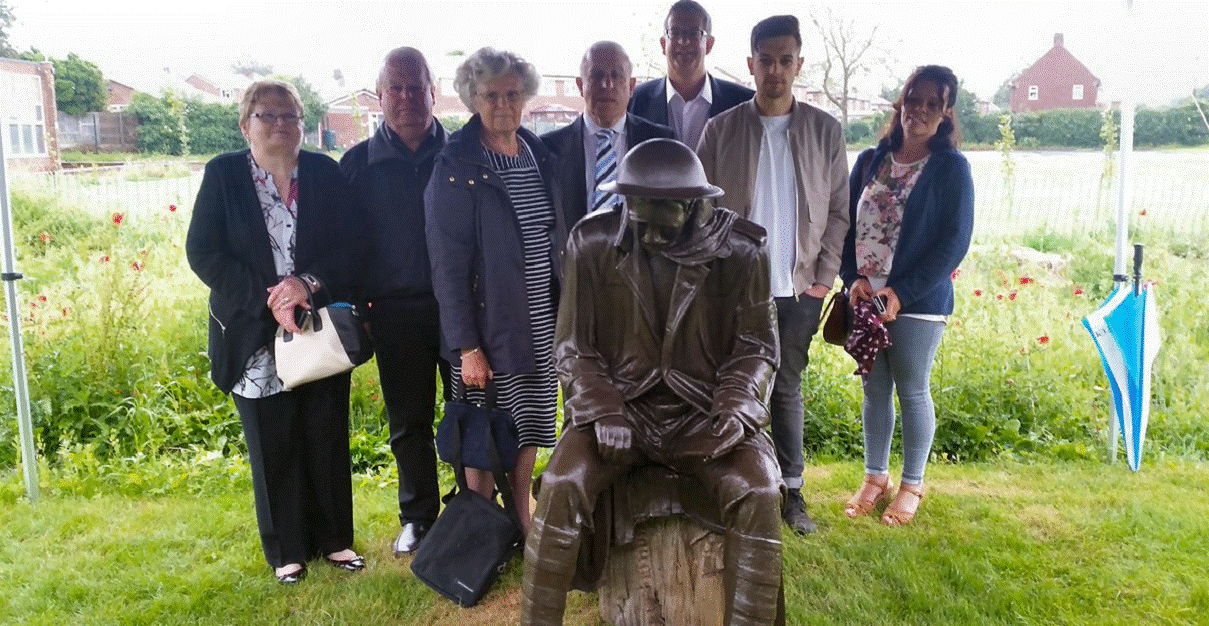
William’s family at the unveiling of
a statue…